Comparative
FrameX Steel Structure vs Traditional Reinforced Concrete Construction
Compare FrameX with traditional construction across key criteria — construction time, investment cost, span capability, durability, and sustainability — to help homeowners choose the most suitable solution.
10 min read
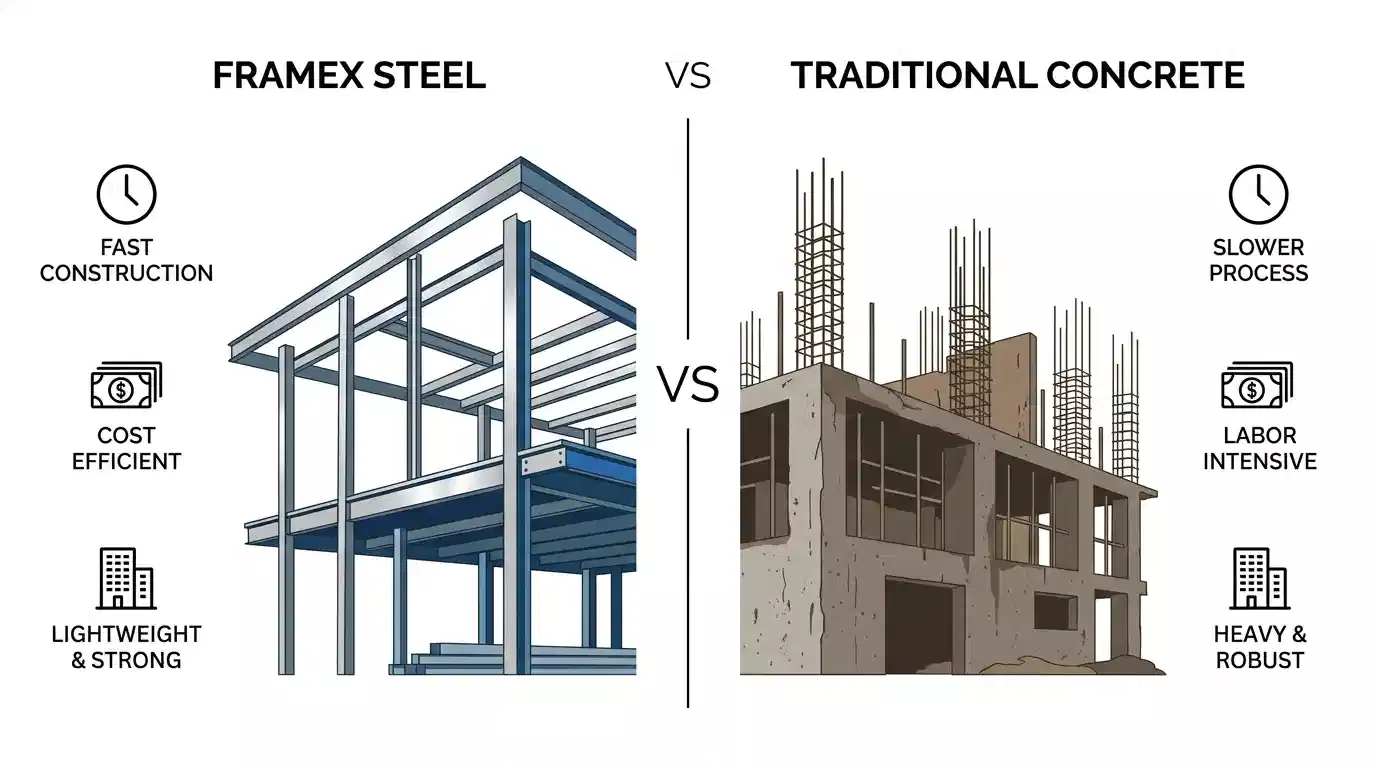
When choosing a construction method, homeowners and developers usually care most about four factors: construction time, investment cost, structural performance, and long-term flexibility. Below is a comparison between FrameX pre-engineered steel construction and traditional reinforced concrete construction to help you make a clearer decision.
1. Construction Time
For the same project scale, steel structure offers a clear advantage in delivery speed.
For example, a 100m² x 3-storey house can typically be completed in about 3 months using steel structure, while reinforced concrete construction may take around 6 months.
That means steel construction can reduce the construction timeline by nearly half, making it a strong choice for projects that need to be operational quickly.
2. Investment Cost
Investment cost depends on project size.
For smaller buildings, such as homes under 210m² (3 floors x 70m²), steel structure is often 10–20% more expensive than reinforced concrete.
However, for projects from 210m² upward, steel structure may become 10–15% more cost-effective thanks to improved structural efficiency, shorter timelines, and better labor optimization.
3. Structural Performance and Span
Steel structure has a clear advantage in long-span capability, often reaching around 9–13m, while reinforced concrete usually performs around 7m.
In terms of lifespan, both systems can achieve long service life when properly designed and executed.
Steel structure also offers a major benefit in upgrading, expansion, and future adaptability.
4. Sustainability
From a sustainability perspective, steel structure has the advantage of easy dismantling, reuse, and reduced construction waste.
Steel members retain value after dismantling, while reinforced concrete is generally harder to reuse and generates more debris.
5. Summary of Pros and Cons
FrameX Steel Structure
- Faster construction
- More suitable for larger projects
- Easier to upgrade and expand
- More environmentally friendly
- Better for large spans and open spaces
- Can be more expensive for smaller projects
- Less suitable for highly decorative detailing
Reinforced Concrete
- Flexible architectural shaping
- Better for smaller projects
- Common in traditional design
- Slower construction
- Affected by weather conditions
- Harder to control consistency on site
- More difficult to expand later
6. 2025 Reference Pricing
Steel structure pricing- Pre-engineered steel warehouse construction: VND 1,500,000 – 2,500,000 / m²
- Foundation work (weak soil): VND 1,500,000 – 2,500,000 / m²
- Foundation work (average soil): VND 800,000 – 1,500,000 / m²
- Finishing works (paint, doors, roof, waterproofing): VND 1,000,000 – 2,000,000 / m²
- Total turnkey cost: VND 2,500,000 – 6,000,000 / m²
Reference reinforced concrete home pricing
- Turnkey home construction: VND 4,700,000 / m²
- Structural shell only: VND 3,400,000 / m²
Conclusion
If your priority is faster delivery, open space, future expansion, and efficiency for larger buildings, steel construction is a strong option worth considering.
If your project is smaller, needs traditional architectural detailing, or prioritizes form flexibility, reinforced concrete may still be the right solution.
FrameX can support you in selecting the most suitable construction method based on your actual project needs.